Practice Update November 2026
Making the most of the new tax rates and super limits
A tax cut can disappear into the weekly grocery bill before anyone notices. A higher superannuation contribution limit can also pass by without changing a household’s plans. But the changes for 2026–27 offer a useful reason to pause, check the numbers and decide where spare money will do the most good.
For individuals and families, the aim is to connect tax planning with real priorities: paying the bills, reducing expensive debt and building retirement savings. October leaves time to make manageable changes before the end of the financial year.
What has changed this financial year
From 1 July 2026, the resident income tax rate applying between $18,201 and $45,000 fell from 16% to 15%. For someone with taxable income of at least $45,000, that rate change reduces annual income tax by $268 compared with 2025–26. The rate is scheduled to fall again to 14% from 1 July 2027.
These are marginal rates: they apply to the income within each band, not to every dollar earned. Taxable income is broadly assessable income less allowable deductions. The figures below isolate the rate change and assume the same taxable income in both years. They exclude Medicare levy, tax offsets and other measures.
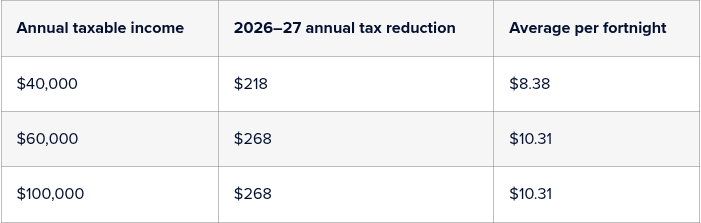
The benefit may already be reflected in tax withheld from wages. It may not show up as an extra refund at tax return time. Actual take-home pay also depends on other payroll deductions and personal circumstances.
Case study: turning a small saving into a habit
Mia and Daniel expect taxable incomes of $60,000 and $100,000 respectively. Together, the rate change represents $536 over a full year, or about $20.62 a fortnight.
They decide to transfer $21 each fortnight into a separate emergency account. Over 26 transfers, they will put aside $546 before interest. That is slightly more than their combined tax reduction, so their budget needs to cover the difference.
Starting in October will not produce 26 transfers before June. The couple can count the remaining paydays and set a realistic first target. A useful step is to make the transfer automatic while keeping enough in their everyday account for bills.
A higher super cap creates more planning room
The general concessional superannuation contributions cap increased from $30,000 to $32,500 for 2026–27. Concessional contributions are generally before-tax contributions, including employer payments, salary sacrifice and personal contributions claimed as a tax deduction.
The cap applies across all super funds. It is not an extra $32,500 that an employee can personally contribute on top of employer payments. Someone expecting $12,000 from their employer and already salary sacrificing $5,000 would ordinarily have $15,500 of the general cap remaining.
That calculation is only a starting point. Bonuses, another job and the timing of payments received by funds can change the total. Check the ATO online record alongside current fund transactions, because reporting may not be immediate.
Case study: the tax effect of an extra contribution
Priya, aged 42, expects taxable income of $100,000 before an additional personal super deduction. Her employer contributions for the year are expected to total $12,000, with no other concessional contributions. She has emergency savings and can afford to commit $4,000 to retirement.
If she makes a valid deductible contribution of $4,000, her taxable income falls to $96,000. In this simplified example, the contribution reduces income taxed at 30%, and the ordinary 2% Medicare levy also falls.

Her expected total concessional contributions would be $16,000, below the $32,500 general cap. The $680 advantage is the difference between the $1,280 personal tax reduction and the $600 contributions tax. It is not a guaranteed investment return.
This example assumes full-year tax residency, an eligible taxed super fund, a valid deduction and no student loan, Medicare levy surcharge, relevant offsets or benefit interactions. The $1,280 reduction is realised through her tax assessment; it does not make the full $4,000 available for spending again.
Strategies for choosing where spare money goes
Protect access to cash first. Super is generally unavailable until a condition of release is met. A household expecting unpaid leave, school costs or a major repair may need accessible savings more urgently than a larger retirement balance.
Compare debt costs next. Paying down expensive debt can improve the budget immediately. For a home loan with a suitable offset account, keeping savings accessible may also reduce interest. Fees, the loan rate and whether the account fully offsets the loan all matter.
For example, keeping $4,000 in a fully linked 100% offset account against a home loan charging 6% could save approximately $240 over a year. This assumes the balance and rate stay unchanged and ignores fees. It is an illustration, not a current market rate or a forecast.
The offset and super examples measure different benefits. One provides ongoing interest savings while preserving access; the other shows an upfront tax advantage on money committed to retirement. Neither number alone decides which choice suits a household.
Consider smaller regular contributions. Salary sacrifice can spread the cash impact over future pay, while a personal contribution may suit irregular income. Either approach needs an annual cap check and a workable budget.
Review the plan when circumstances change. A pay rise, parental leave or a second job can alter both taxable income and available cash. For a household putting $150 a month aside, a three-month pause reduces annual savings by $450. Building that possibility into the budget is more useful than assuming every month will look the same. A regular check also helps prevent an affordable commitment in October from becoming a cash squeeze by March.
Unused caps may offer an opportunity
Someone whose total super balance was below $500,000 at 30 June 2026 may be able to use unused concessional cap amounts from the previous five financial years. These amounts can increase the available cap above $32,500.
For example, $6,200 of available unused cap could lift a person’s total concessional limit to $38,700. Employer and other concessional contributions still count towards that total. Current-year cap space is used first, followed by the oldest available amounts.
Unused amounts expire after five years. Available amounts from 2021–22 therefore need attention before 30 June 2027. A larger cap does not automatically make a larger contribution affordable or tax-effective; the person’s income, access needs and eligibility still matter.
Get the paperwork and timing right
A personal contribution does not automatically create a deduction. The member must give the fund a valid notice of intent and receive its acknowledgement before claiming. The notice is generally due by the earlier of tax return lodgement or the end of the following financial year.
A rollover, withdrawal or pension commencement can affect the validity or amount of a notice. The paperwork should therefore be addressed before moving the relevant money. Contribution acceptance rules and, for some older members, work-test requirements also need checking.
Payments intended for a financial year generally need to reach the fund by 30 June. Fund processing cut-offs can be earlier. Leaving a transfer until the last banking day creates an avoidable risk.
A practical check-up before the next payday
A useful review starts with expected annual income, current debts, accessible savings and all super contributions made or planned. The household can then choose one affordable action and set a date to review it.
An accountant can check the tax calculation, available contribution space and lodgement requirements. If you’re choosing financial products or a personal retirement strategy, a licensed financial adviser can help assess suitability. These examples are general information and use fictional households; outcomes depend on individual circumstances.
FAQ
- Does everyone receive a $268 refund? No. The figure isolates the annual rate reduction for taxable income of at least $45,000; withholding and the final tax calculation determine any refund.
- Is the $32,500 cap separate for each fund? No, it applies across funds and includes employer contributions.
- Can anyone claim a personal super deduction? No, eligibility and notice requirements must be met.
- Can unused cap amounts be kept indefinitely? No, they generally expire after five years, and the prior 30 June balance test applies.
- Should spare cash always go into super? No, debt costs, emergency savings, access needs and personal circumstances should guide the decision.