Practice Update August 2026
New CGT rules from 1 July 2027
The new rules at a glance
What has changed
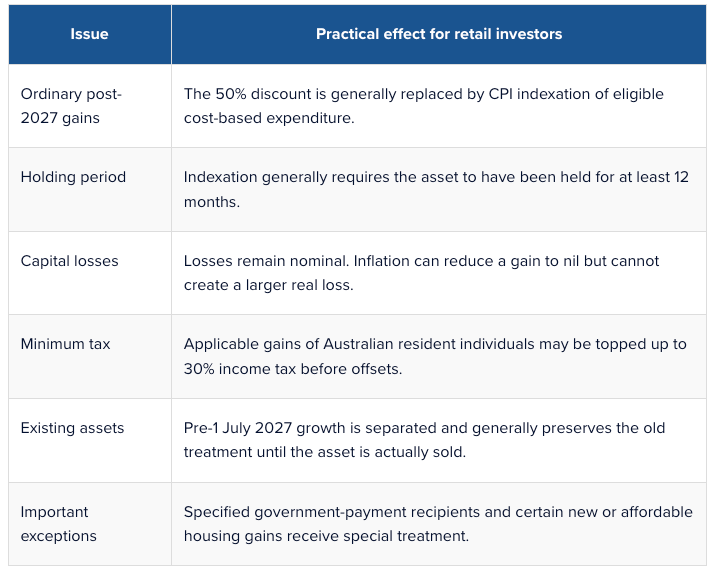
Under the old rules, an individual who held an eligible CGT asset for at least 12 months generally included only 50% of the nominal capital gain in taxable income. Inflation did not directly change the cost base.
Under the new rules, ordinary post-30 June 2027 gains generally receive no 50% discount. Instead, eligible cost-based expenditure is indexed for inflation if the asset has been held for at least 12 months. Indexation reduces a capital gain, but it does not enlarge a capital loss. In other words, an investment that rises in dollars but falls in real purchasing power can produce no taxable gain. Yet, it does not produce an inflation-adjusted capital loss that can offset a winner.
For Australian resident individuals, the new minimum-tax calculation may result in additional income tax, so that applicable capital gains are subject to at least 30% income tax before offsets. It is a floor, not a universal flat rate. A person already paying tax at 30% or more on the gain may have little or no top-up. The floor does not apply if the investor receives certain government payments during the income year, including the Age Pension, JobSeeker Payment, Parenting Payment or Family Tax Benefit. Ordinary CGT can still apply.
Assets owned at 30 June 2027 are not simply taxed under a single system. The law creates a deemed sale just before 1 July 2027 and a deemed reacquisition on 1 July 2027, generally at market value. Any gain or loss on that notional sale is deferred until the asset is actually sold. An eligible pre-1 July 2027 gain can still receive the old 50% discount, while later growth is generally dealt with under indexation. There is no automatic tax bill merely because 30 June 2027 arrives.
Case study 1: When indexation is a clear winner
Alex invests $100,000 in a broad-market exchange-traded fund (ETF) and holds it for 10 years. Assume both the ETF and inflation rise by 3% a year. The ETF is sold for about $134,392.
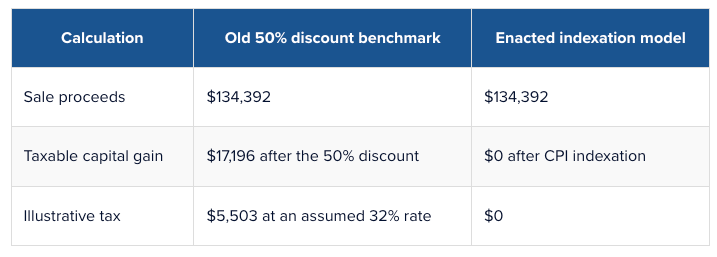
Economically, Alex has merely kept pace with inflation. Under the old discount approach, the nominal gain would be $34,392. After the 50% discount, $17,196 would be taxable. At an assumed marginal rate of 32%, including the Medicare levy, the tax would be about $5,503.
Under indexation, the $100,000 cost base also rises to about $134,392. There is no real capital gain, so the CGT outcome is nil. This is the strongest argument for the reform: tax is less likely to be imposed on an increase that only preserves purchasing power.
The important catch is symmetry. If the ETF sold for $125,000, Alex would have a nominal gain but a real loss after inflation. The indexed gain would be nil, but there would generally be no capital loss to carry forward because the sale proceeds still exceed the unindexed reduced cost base.
Why direct-share portfolios can be hit differently
A diversified share portfolio rarely moves as one smooth investment. A few companies may become large winners, while several others rise slowly, stagnate or fail.
This matters because CGT is calculated asset by asset. A share that rises from $10,000 to $14,800 has made a nominal gain. If inflation has doubled the purchasing-power cost base to $20,000, the investment has lost $5,200 in real terms. Under the new rules, the taxable gain may be reduced to nil, but that $5,200 real loss is not available to offset a large real gain on another share.
Case study 2: the diversified portfolio problem
Consider Priya, who puts $10,000 into each of four shares and holds them for 20 years. Assume inflation averages 3.5% a year, so each $10,000 cost base roughly doubles to $20,000.
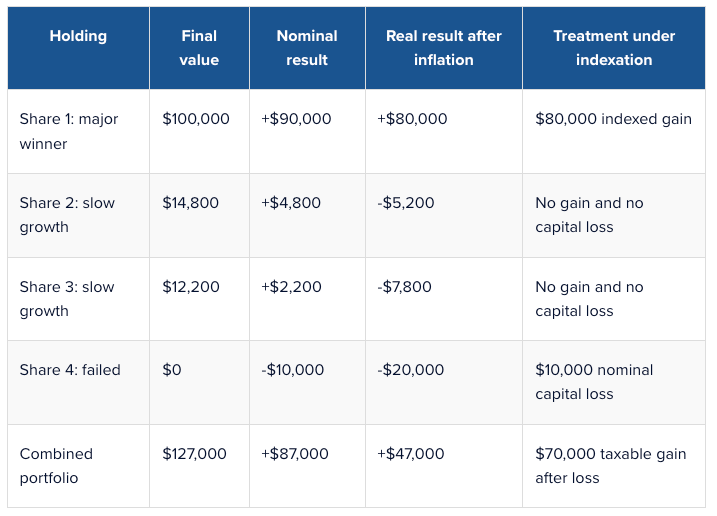
One share becomes a tenfold winner, worth $100,000. Two shares grow slowly to $14,800 and $12,200. The fourth company fails and becomes worthless. The portfolio is worth $127,000. Against an inflation-adjusted total cost of $80,000, Priya’s real economic gain is about $47,000.
If the old 50% discount had continued, the nominal gains and the $10,000 nominal loss would net to $87,000. The discounted taxable gain would be $43,500. At a 47% marginal rate, including the Medicare levy, the tax would be about $20,445.
Under the enacted indexation model, the tenfold winner produces an $80,000 indexed gain. The two slow growers produce no taxable gains, but their combined $13,000 of real underperformance does not result in a capital loss. The failed share produces only a $10,000 nominal capital loss. The taxable gain is therefore $70,000, and the tax at 47% is $32,900.
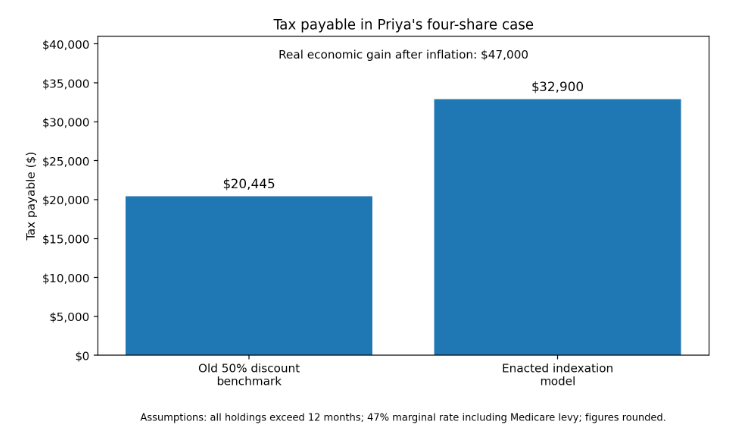
Figure 1. Tax payable in Priya’s four-share case.
Source: author calculation using the assumptions in the case study. The numerical comparison is recycled from the supplied graphic and updated to refer to the enacted model.
The effective tax shown as 70% is not the legal marginal tax rate. It is a tax of $32,900 measured against the portfolio’s $47,000 real economic gain. The gap arises because some real losses are not recognised for CGT purposes.
Do ETFs automatically win?
Broad, low-turnover index ETFs may become relatively more attractive under this particular rule. At the investor level, each parcel of ETF units is treated as a single CGT asset. Winners and losers are managed within the pooled portfolio, and the unit price reflects the combined result. This can reduce the asset-by-asset mismatch seen in a hand-picked portfolio.
However, ETFs are not tax-free wrappers. Australian ETFs are typically structured as trusts and may distribute capital gains to investors. Investors may also need to make attribution-managed investment trust (AMIT) cost-based adjustments based on their annual statements. A thematic or high-turnover ETF can realise and distribute more gains than a broad, low-turnover index fund. Fees, tracking error, distributions, franking credits and investment risk still matter.
Direct shares also retain advantages. Investors control which company and parcel to sell, can realise genuine nominal losses, may avoid inheriting a fund’s taxable distribution, and can design a portfolio around income or franking preferences. The new tax rules strengthen the case for comparing structures, but they do not make ETFs the right answer for everyone.
Who is likely to win and who may lose?
Likely winners may include investors whose long-term returns are close to inflation; eligible investors in broad, low-turnover pooled funds; people who receive one of the specified support payments and are therefore outside the 30% minimum-tax top-up; and investors in qualifying new residential dwellings or affordable housing, where special discount choices can remain available.
Potential losers include investors in high-growth assets that would have benefited more from halving the nominal gain; self-funded retirees and other lower-income investors who do not receive a specified payment and are caught by the 30% floor; investors holding assets for less than 12 months, because indexation generally requires a 12-month holding period; and direct-share investors whose portfolios contain a small number of large winners and several inflation-underperforming shares.
The return comparison graph shows the trade-off. In an illustration involving a $100,000 asset held for 10 years, 3% annual inflation, and a 47% marginal rate, indexation results in lower tax at lower nominal returns. At roughly 5.4% nominal annual growth, the two methods are about even. Above that point, the old 50% discount would usually have produced less tax. The exact break-even point changes with inflation, the holding period, costs and the investor’s tax rate.
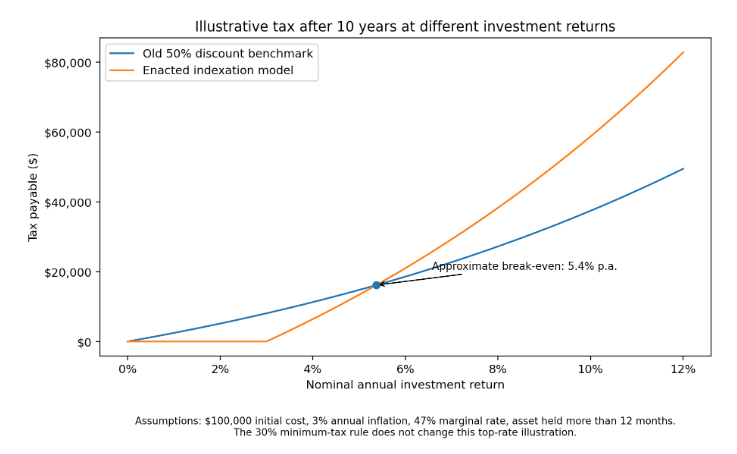
Figure 2. Illustrative tax at different nominal annual investment returns.
Source: author calculation based on a $100,000 investment, 3% annual inflation and a 47% marginal rate. This is an illustration, not a forecast.
Case study 3: the 30% floor for a self-funded retiree
Mary is an Australian resident self-funded retiree. After indexation and capital losses, she has an applicable capital gain of $50,000. Suppose the ordinary income-tax calculation attributes $8,000 of tax to that gain. The minimum-tax formula starts with 30% of $50,000, or $15,000, and may add $7,000 so that the pre-offset income tax attributable to the gain reaches the floor.
If Mary received an Age Pension payment at any time during that income year, the minimum-tax top-up would not apply. She could still pay ordinary income tax on the gain. This distinction means two retirees with similar portfolios can have different outcomes depending on their support-payment status and other taxable income.
A practical flowchart for sales after 1 July 2027
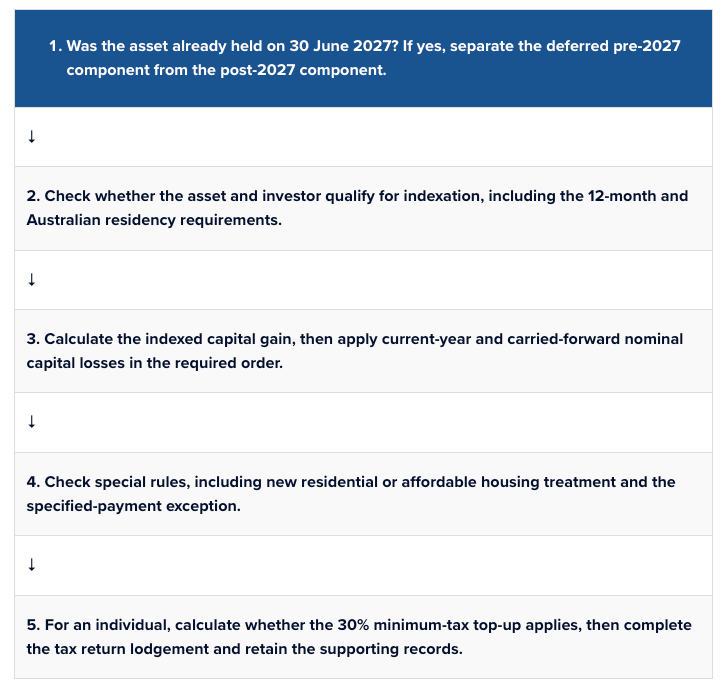
TSeven sensible strategies before and after 1 July 2027
1. Build a 30 June 2027 evidence file. Save broker statements, parcel records, dividend reinvestment plan details, corporate-action documents and reliable market-value evidence for shares, ETFs, managed funds and other assets. Each reinvested parcel can have its own acquisition history.
2. Do not panic-sell solely to lock in the old discount. The transition rules are designed to preserve eligible pre-1 July 2027 gains and defer them until the real sale. A sale before the change may still make sense for investment or cash-flow reasons, but it brings forward tax and transaction costs.
3. Compare investments on after-tax return, not tax alone. A broad ETF may reduce portfolio dispersion, but it may also charge fees or distribute gains. A direct portfolio may offer control but require more records and create more asset-by-asset tax variation.
4. Use genuine capital losses thoughtfully. A real disposal of a nominal loser can offset capital gains. Selling and quickly reacquiring substantially the same exposure, mainly to manufacture a tax loss, can be treated as a wash sale and challenged under anti-avoidance rules.
5. Review sale timing and parcel selection. Spreading disposals across income years, selecting particular parcels and coordinating gains with genuine losses may still help. The 30% floor reduces the benefit of moving a gain into a very low-income year, but timing can still affect Medicare, offsets, support payments and other tax outcomes.
6. Review ownership structures before transferring assets. Superannuation, trusts and personal ownership can produce different outcomes, but moving an existing asset can itself trigger CGT, duty, contribution-cap issues or access restrictions. The tax result should be considered alongside investment control and retirement objectives.
7. Get advice before changing tax residency. The indexation rules contain strict residency conditions. A move overseas, temporary residency status or a trust distribution to different beneficiaries can change the outcome.
The bottom line
The new system is neither an across-the-board tax increase nor an automatic gift to ETF investors. It is more favourable when an asset’s return is modest relative to inflation. Still, it can be less favourable for high-growth assets and diversified direct portfolios with uneven winners and losers. The 30% minimum-tax floor also shifts some of the burden towards self-funded retirees and lower-income investors who do not receive a listed support payment.
The best response is not a rushed portfolio change. It is better record-keeping, scenario modelling and deliberate asset selection. Before 1 July 2027, investors should document market values and parcel histories. After that date, investment decisions should be tested under both economic and tax rules, with professional advice when the amounts are material.
Important note
This article is general information only and discusses investments held on a capital account. Frequent share traders may be taxed under ordinary income rules. The examples simplify CPI indexation, tax rates and transaction costs and should not replace personal tax or financial advice.