Practice Update September 2026
Australia has no inheritance tax. So why can an inheritance still create a tax bill?
Receiving an inheritance is usually associated with one reassuring piece of tax information: Australia does not have an inheritance tax.
That is correct. There are no inheritance or estate taxes in Australia simply because a person receives money or assets from a deceased estate.
But that does not necessarily mean an inheritance is tax-free.
The distinction is important.
Receiving $200,000 in cash from an estate may have no immediate tax consequences. Receiving a $900,000 investment property, a portfolio of shares or a superannuation death benefit worth $500,000 can be very different.
Tax may arise when an inherited asset is later sold. Income earned by inherited investments can be taxable. Superannuation death benefits can also be taxed differently depending on who receives them.
The result is that two beneficiaries receiving inheritances of exactly the same value can end up with very different amounts after tax.
Understanding a few common inheritance myths can therefore help families plan and avoid unexpected tax consequences.
Myth 1: If Australia has no inheritance tax, an inheritance is tax-free
Australia does not generally tax a beneficiary simply for receiving an inheritance.
For example, suppose Maria dies and leaves her daughter, Anna, $300,000 held in a bank account.
Anna does not normally include the $300,000 inheritance as income in her tax return simply because she received it.
But consider a slightly different situation.
Instead of cash, Maria leaves Anna an investment property worth $900,000.
Anna again does not normally pay tax just because the property has passed to her. However, capital gains tax (CGT) may become relevant when
Anna eventually sells it. The Australian Taxation Office explains that CGT generally does not apply simply because a beneficiary inherits a
dwelling. Still, it may apply when the property is later sold or otherwise disposed of.
Similarly, if Anna inherits shares, she generally does not pay tax merely because she receives them. But dividends received after she inherits the shares can be taxable, and selling the shares later may result in a capital gain or capital loss.
The important question is therefore not simply:
“Do I pay tax when I inherit?”
It should also be:
“What tax consequences come with the assets I am inheriting?”
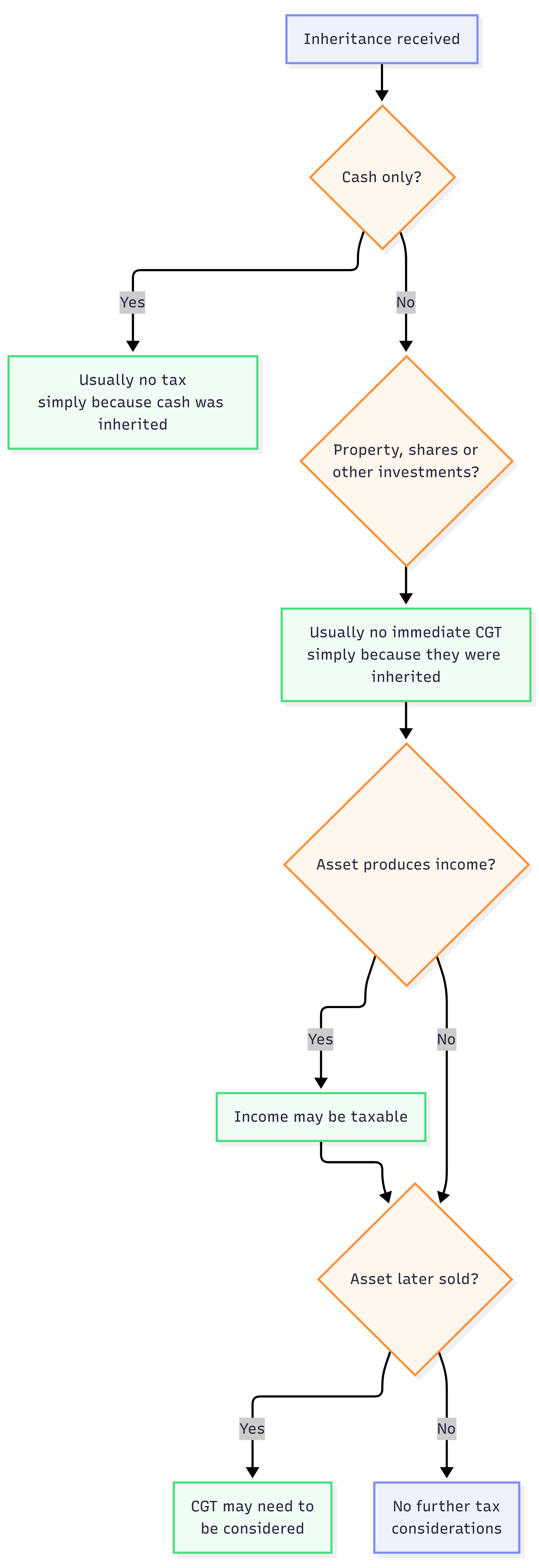
A simple inheritance tax flow
Myth 2: I inherited the family home, so I will never pay CGT on it
The family home receives significant tax concessions in Australia, but an inherited home is not automatically exempt from CGT forever.
Special rules apply to dwellings inherited from a deceased person.
In some circumstances, a beneficiary or executor can sell an inherited dwelling within two years of the deceased person’s death without CGT applying. Whether the full exemption is available depends on factors including when the deceased acquired the property, whether it was their main residence and whether it was being used to produce
income.
The two-year period can therefore become important.
Case study: Selling mum’s
home
Helen purchased her home in 1998 for $240,000.
It was her main residence until her death in January 2026, and it was not being rented out immediately before that.
Her son, David, inherits the house.
At Helen’s death:
- estimated market value: $850,000
- value when eventually sold: $920,000
- increase since Helen’s death: $70,000.
David sells the property and settlement occurs 18 months after Helen’s death.
Assuming the relevant conditions for the inherited main residence exemption are satisfied, the sale may be fully exempt from CGT even though the property increased in value by $70,000 after Helen died.
Now suppose the family delays the sale for several years.
Perhaps one child lives in the house, the beneficiaries cannot agree whether to sell, or the property is rented out.
The tax outcome can change.
Some provisions can extend the two-year period where disposal is delayed by qualifying circumstances outside the beneficiary’s or trustee’s control. Still, families should not simply assume that an extension will be available.
This is why the period immediately after an inheritance can matter.
A decision that appears to be about whether to “keep Mum’s house for a while” may also be a tax decision.
Myth 3: The cost of an inherited asset always resets to its value when the
person dies
This is another common misunderstanding.
When someone inherits an asset, it can be tempting to think that its starting value for CGT purposes is its market value on the date of death.
Sometimes that is correct.
Sometimes it is not.
The rules can depend on matters such as when the deceased originally acquired the asset and, for a dwelling, whether it was the deceased’s main residence and whether it was being used to produce income. For certain assets acquired by the deceased before CGT commenced on 20 September 1985, the market value at the date of death may be relevant. For many post-CGT assets, the beneficiary effectively takes over the deceased’s cost base instead.
This can produce a surprisingly large difference.
Case study:
The investment property bought years ago
George purchased an investment property for $300,000 in 2004.
Assume that after allowing for eligible acquisition costs and capital expenditure, George’s CGT cost base immediately before his death is $360,000.
When George dies, the property is worth $650,000.
His daughter, Sophie, inherits it.
Three years later, Sophie sells the property for $760,000.
Sophie might initially expect the capital gain to be:
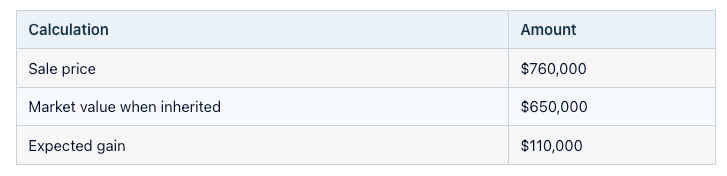
But if the applicable rules mean Sophie inherits George’s $360,000 cost base, the starting calculation could instead look like this:
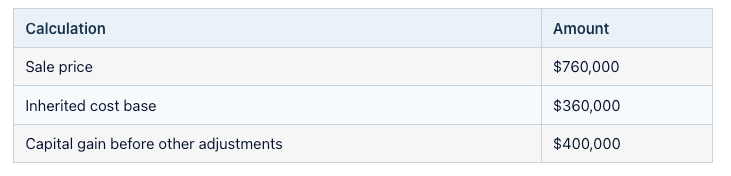
That is a substantial difference.
Other selling costs, eligible cost-base expenditure, capital losses and the CGT discount may affect the final taxable capital gain. An individual beneficiary may also be able to access the 50% CGT discount where the relevant requirements are satisfied.
The important lesson is not to rely on the property’s value at the date of death without first determining which cost-base rules apply.
It also highlights something much less exciting but extremely valuable in estate planning: keeping records.
Purchase contracts, legal costs, stamp duty records, renovation invoices and details of major improvements can become important many years later.
A beneficiary trying to reconstruct the cost of a property purchased by a parent 25 years ago can face a difficult job if those records no longer exist.
Myth 4: Superannuation inherited by the children is always tax-free
Superannuation can be one of a family’s largest assets, yet its treatment after death is often misunderstood.
A superannuation death benefit is not necessarily taxed in the same way as ordinary estate assets.
The tax outcome depends on several factors, including who receives the benefit and the components making up the deceased person’s superannuation balance.
For tax purposes, a spouse or de facto spouse is generally treated as a death benefits dependant. A child under 18 can also qualify, as can certain financially dependent people and people in an interdependency relationship with the deceased. An adult child who was not financially dependent on the deceased will generally not be a death benefits dependant simply because they are the deceased person’s child.
That distinction can have a significant tax consequence.
A lump-sum super death benefit paid to a tax dependant can generally be received tax-free.
For a non-dependant, however, the taxable component can be subject to tax. The taxed element is generally subject to a maximum income tax rate of 15% plus Medicare levy. In comparison, an untaxed element can be subject to a maximum rate of 30% plus Medicare levy.
Case study: The same super balance, two different outcomes
Assume Michael has a $500,000 superannuation death benefit consisting of:
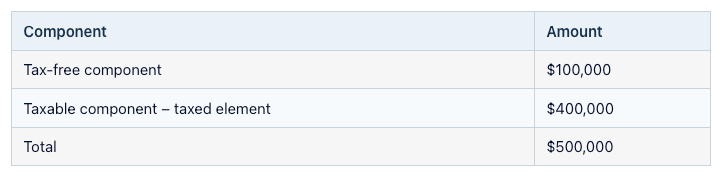
Consider two possible beneficiaries.
Scenario 1: Michael’s spouse receives the lump sum.
Assuming the spouse qualifies as a death benefits dependant for tax purposes, the lump-sum death benefit can generally be received
tax-free.
Scenario 2: Michael’s 35-year-old son receives the lump sum.
His son lives independently, earns his own income and was not financially dependent on Michael.
If the son is a non-dependant for tax purposes, the $400,000 taxed element could be subject to tax of up to:
$400,000 × 15% = $60,000
Medicare levy may also apply.
The same $500,000 super balance can therefore produce a materially different after-tax benefit depending on who ultimately receives it.
This is one reason estate planning should look beyond the wording of the will and consider superannuation separately.
Myth 5: Once I receive the inheritance, there is nothing more to report
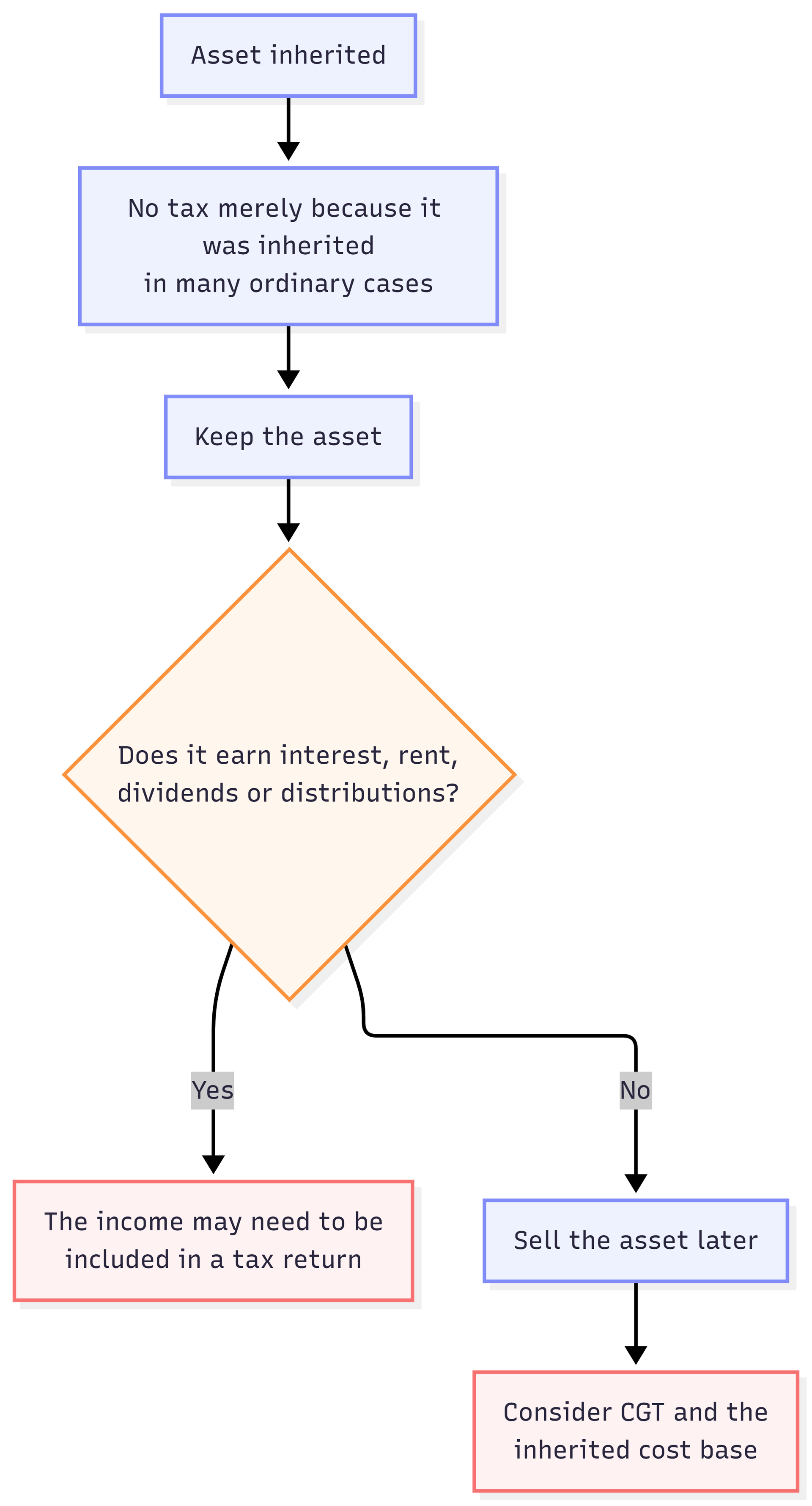
Receiving an inheritance and earning income from that inheritance are two different things.
Suppose James inherits $400,000 in cash.
Receiving the $400,000 itself will generally not result in inheritance tax.
James places the money in a term deposit paying 4.5%.
Over the following year it generates:
$400,000 × 4.5% = $18,000
That $18,000 of interest is income earned by James. It may form part of his assessable income even though the original $400,000 came from an inheritance.
The same principle can apply to other inherited assets.
An inherited rental property can start generating taxable rental income.
Inherited shares can pay taxable dividends.
Inherited investments can produce interest, distributions or capital gains.
The Australian Taxation Office distinguishes between receiving the inheritance itself and subsequent income earned from inherited assets.
What happens after an asset is inherited?
Myth 6: Two children receiving $500,000 each have received equal inheritances
Estate planning often focuses on the headline value of assets.
But equal market values do not necessarily produce equal financial outcomes.
Consider a parent who wants to leave $1 million equally between two adult children.
Child one receives $500,000 in cash.
Child two receives an investment property worth $500,000.
On the day the estate is distributed, both appear to have received the same amount.
But the property may carry an embedded capital gain because of its historical cost base. It may require ongoing maintenance. Selling it can involve agent’s fees and other costs. Rental income may be taxable.
The cash does not carry those same characteristics.
The same issue can arise when one child receives superannuation, and another receives assets from the estate.
The appropriate comparison may therefore be not simply:
“What is each asset worth today?”
but:
“What is each beneficiary likely to receive after allowing for tax, costs, liquidity and the characteristics of the asset?”
This does not mean every estate should be divided according to estimated future tax liabilities. Future circumstances and asset values
can change.
It does mean that tax should form part of the conversation.
Why estate planning should involve more than preparing a will
A will remains a central estate-planning document, but effective estate planning typically requires a broader understanding of a person’s financial affairs.
For many families, that means identifying:
- personally owned assets
- jointly owned assets
- investment properties
- shares and other investments
- superannuation
- business interests
- companies and trusts
- loans and liabilities
- potential CGT cost bases
- beneficiary circumstances.
Your accountant can be particularly useful in bringing these pieces together.
For example, an accountant may already hold records showing when an investment property was purchased, its historical cost base, whether it has been rented, the ownership structure of a family business and the client’s superannuation position.
The solicitor can then address the legal estate-planning documents and succession arrangements, while financial advice may also be required where investment, insurance or superannuation strategies are involved.
Estate planning is therefore often best approached as a coordinated exercise rather than simply preparing a will and putting it away.
Five questions worth asking about your own estate plan
A useful starting point is to ask:
- What assets would actually form part of my estate?
- Which assets could carry a future CGT liability for my beneficiaries?
- Who is likely to receive my superannuation, and could tax apply to the death benefit?
- Do I have adequate records of the cost bases of properties, shares and other long-held investments?
- Would dividing assets equally by market value produce substantially different after-tax outcomes for my beneficiaries?
If any of these questions are difficult to answer, it may be worth reviewing the financial side of the estate plan.
The bottom line
The statement that “Australia has no inheritance tax” is correct, but it tells only part of the story.
Receiving an inheritance often incurs no immediate tax cost. What happens before and after that inheritance can be much more important.
An inherited property may carry a future CGT exposure. The historical cost base may matter more than its value at the date of death. A family home may qualify for valuable exemptions, but timing can be important. Investment income earned after inheritance can be taxable. A superannuation death benefit received by an adult child can have a very different tax outcome from the same benefit received by a spouse.
These issues do not necessarily mean additional tax will be payable. They mean the tax consequences should be understood rather than assumed.
A review with an accountant, together with appropriate legal and financial advice where required, can help identify potential tax consequences while there is still an opportunity to plan for them.
General information only: This article provides general information and does not take into account any person’s particular circumstances. Estate planning, taxation and superannuation outcomes depend on individual circumstances and applicable law. Appropriate professional advice should be obtained before acting.