Practice Update October 2026
Property tax reforms: what investors should review before buying or selling
Australian property investors face two key changes: tighter access to negative gearing and a different capital gains tax (CGT) calculation. The core legislation received royal assent on 26 June 2026, with the principal changes applying from 1 July 2027. Some implementation details remain the subject of further legislation.
The immediate priority is to review acquisition dates, ownership, borrowing and expected cash flow before committing to a transaction. An established property purchased today does not obtain permanent protection merely because settlement occurs before July 2027. Similarly, a property already protected from negative gearing restrictions can still be affected by CGT changes.
This article focuses on Australian resident investors holding property as an investment. Property development, foreign residency, deceased estates and mixed private use can require different treatment. The case studies are illustrative and exclude the Medicare levy and tax offsets unless stated otherwise.
The dates that determine the outcome
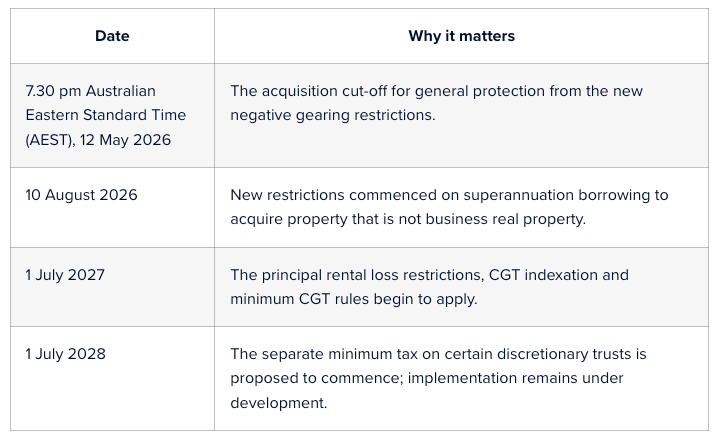
AFor an ordinary contractual purchase, the contract date generally determines acquisition for these purposes. The negative gearing legislation specifically recognises the ownership interest from contract entry. Do not use a deposit payment, finance approval or settlement date as a substitute without checking the actual agreement.
Negative gearing changes the timing of tax relief
Negative gearing arises when deductible property expenses exceed rental income. Under the existing rules, an individual can generally offset that rental loss against other assessable income, including salary, subject to the ordinary deduction requirements.
From 2027–28, losses on affected residential investments will instead be quarantined. They can generally reduce eligible residential property income and residential capital gains, with unused amounts carried forward. They cannot simply reduce wages or unrelated business income.
The restrictions generally exclude an ownership interest acquired before the Budget cut-off and qualifying new dwellings. Protection depends on the relevant investment and ownership history. Selling a protected property and buying an established replacement does not transfer that protection.
An established property acquired after the cut-off can still receive ordinary negative gearing treatment during 2026–27. The cash-flow model must then change for 2027–28. An anticipated annual tax refund should not be treated as a permanent source of mortgage funding.
Case study 1: the same property loss produces different cash requirements
Amelia contracts to buy an established rental property in September 2026. Her other taxable income is $180,000. Annual rent is $31,200, interest is $37,000 and other deductible cash expenses are $11,000. She has no other residential property income or gains.
The following comparison uses the same full-year figures to isolate the change. All of the otherwise deductible loss falls within the assumed 37% income tax bracket. Loan principal repayments and non-cash deductions are excluded.
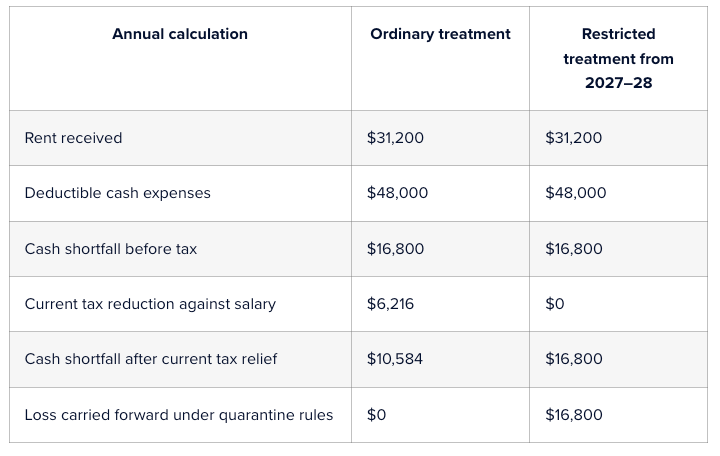
Amelia needs an additional $518 each month to meet the same expenses once the salary offset is unavailable. The carried-forward amount may provide future relief, but it does not pay the current mortgage.
If Amelia instead had $12,000 of eligible net residential rental income from another property, the $16,800 loss could generally absorb that income, leaving $4,800 carried forward. This makes a portfolio review more useful than assessing each property in isolation.
A new dwelling must satisfy the tax definition
Qualifying new dwellings retain access to negative gearing and an option to use the 50% CGT discount. Eligibility should be checked independently of descriptions such as “brand new”, “renovated” or “off the plan”.
The August 2026 exposure draft proposed that a dwelling must genuinely add to housing supply and generally be acquired within 24 months of the occupancy certificate. The definition and related exemptions were released for consultation, so buyers should check the final requirements before signing contracts.
A buyer should obtain the occupancy certificate, construction history and details of previous occupation and sales. A renovation does not automatically qualify. Similarly, a dwelling that qualified for its first investor will not necessarily qualify for a subsequent purchaser.
Tax eligibility also does not establish investment quality. Construction risk, location, rental demand, strata charges and the price premium for new stock remain commercial considerations.
For example, assume two otherwise comparable properties differ in price by $70,000. If buying the qualifying new dwelling preserves an annual tax reduction of $5,000, it would take 14 years of that benefit to equal the price difference, even before financing costs and the time value of money. That comparison is deliberately simplified, but it shows why a tax concession cannot justify an unlimited purchase premium.
Reviewing the rental loss treatment
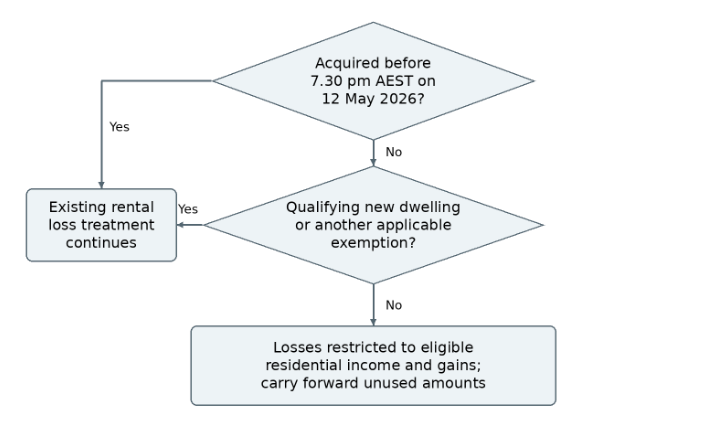
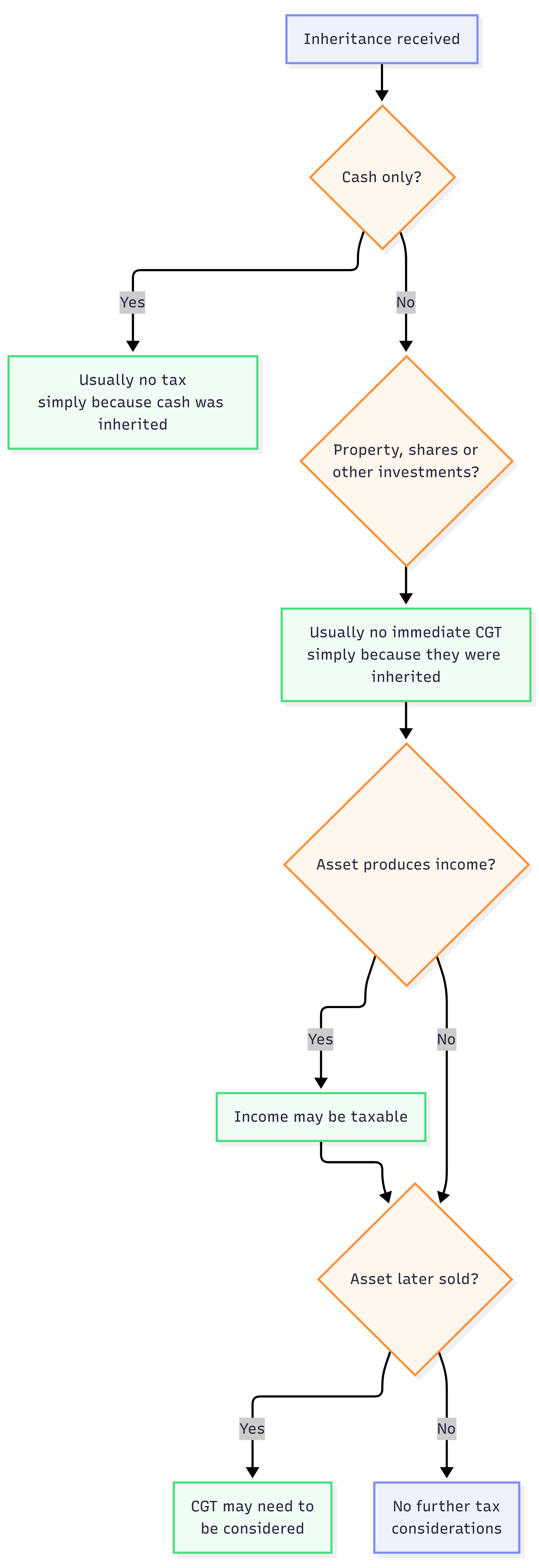
The flowchart summarises the position for an individual investor from 2027–28. Ordinary deductibility requirements continue to apply in every branch.
CGT will distinguish earlier growth from future growth
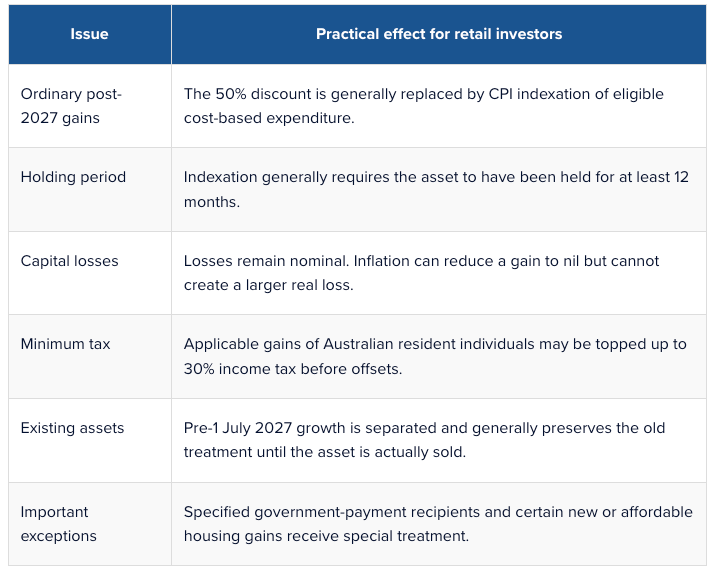
For affected assets, the familiar 50% discount is replaced by indexation for gains accruing from 1 July 2027. Indexation adjusts eligible cost-base amounts using the Consumer Price Index (CPI), so the calculation recognises inflation. Relevant holding-period and eligibility conditions still apply.
This is a different benefit from halving a gain. Where growth substantially exceeds inflation, the taxable gain may be larger than under the discount. Where growth is modest, indexation may produce a smaller taxable gain.
For eligible assets held across the transition, the pre-July 2027 component retains its existing treatment. The legislation separates that component from later growth, generally through a market value at the transition or an authorised alternative apportionment method. The earlier gain is deferred until a later realisation event; the transition does not itself require an ordinary investor to pay tax on an unsold property.
A valuation strategy should therefore be discussed before 30 June 2027. Records should preserve the property’s condition, improvements and comparable sales. An unsupported estimate can affect both components of a future calculation.
Case study 2: an existing property has two CGT components
Daniel bought an established investment property in 2020. Its adjusted cost base is $600,000, its supported value immediately before 1 July 2027 is assumed to be $800,000, and it is later sold for $1,100,000.
For illustration, the applicable indexation factor for the later period is assumed to be 1.08. There are no additional costs, capital losses, quarantined rental losses or other adjustments. Daniel qualifies for the 50% discount on the earlier component.
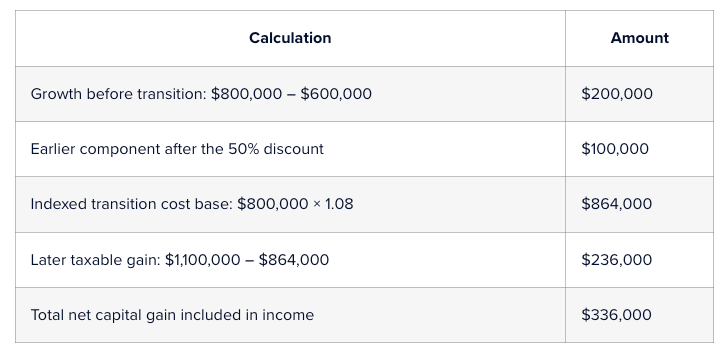
If Daniel’s other income already places him in an assumed 45% bracket, income tax on these components is $151,200. Applying the old 50% discount to the entire $500,000 gain would instead have produced $112,500. The illustrative difference is $38,700.
This is not a forecast of Daniel’s actual liability. Future indexation, expenditure, losses and income will change the result. It demonstrates why protection for rental losses must not be confused with protection for all future capital growth.
Older properties and the family home require separate checks
Assets acquired before 20 September 1985 also require attention. The reforms can bring their post-June 2027 growth into the CGT system while preserving the exemption for earlier growth. A long-held investment property should not be assumed permanently exempt.
The main residence exemption continues, subject to its conditions. A former home, holiday property or dwelling partly used to produce income may have only a partial exemption. Review occupancy dates, rental periods and relevant valuations before estimating the taxable gain.
Converting a home into a rental also deserves advice at the time of conversion. Existing rules may require a market value when a home is first used to produce income. Further draft measures address how eligible former homes interact with the reforms. Retaining valuation evidence and a clear history of use allows the adviser to test the applicable rules without assuming that every former home receives identical protection.
The minimum tax changes low-income sale strategies
A minimum 30% income tax rate applies to certain post-transition capital gains of Australian resident individuals. It operates through an additional tax calculation where ordinary income tax attributable to the relevant gain is below that floor. It is neither a flat rate for every property sale nor a ceiling for higher-income investors.
Exceptions include recipients of specified government payments. Retirement by itself does not establish an exemption. Eligible new-dwelling discount treatment also needs to be distinguished from the indexation and minimum-tax pathway.
Case study 3: retiring before a sale does not guarantee a low rate
Priya has $30,000 of other taxable income and a $12,000 capital gain subject to the minimum tax in 2028–29. She receives no qualifying government payment. Using the legislated 14% bracket for this income range, ordinary tax attributable to the gain is $1,680.
The 30% amount is $3,600. The additional income tax is therefore $1,920, before considering offsets and the Medicare levy. Timing a sale for a lower-income year may still help with other income or earlier gains, but you must include the minimum-tax calculation.
Strategies before buying
Model the investment without an immediate rental-loss refund
Purchase modelling should include interest, rates, insurance, management fees, maintenance, strata charges and vacancy. Loan principal repayments must be included in the cash budget even though they are not deductible.
A separate stress test should allow for higher interest and lower rent. For example, a one-percentage-point increase on a $600,000 interest-only loan adds $6,000 annually. If the extra deduction is quarantined, the immediate funding requirement remains the full $500 per month.
Assess expected capital growth separately from annual affordability. A property can have attractive long-term prospects and still create an unsustainable short-term cash requirement.
Choose ownership before signing
Individual ownership, joint ownership, a company and a trust have different tax consequences. A company does not obtain the individual 50% CGT discount, and moving losses into a company does not make them deductible against a shareholder’s salary. Residential loss restrictions can also apply to companies and most trusts.
The proposed 30% minimum tax on certain discretionary trusts from July 2028 adds another consideration. September 2026 exposure drafts address its implementation and restructuring relief. Those proposals should be distinguished from the core property reforms already enacted.
Changing ownership later can trigger CGT, transfer duty, finance costs and loss of grandfathering. A transfer between spouses is not automatically tax-free. State duty exemptions have their own conditions; for example, Victoria’s ordinary spouse exemption includes residence requirements and does not provide a general exemption for investment-property transfers.
Joint owners should also model their actual ownership shares and individual income positions. A couple cannot ordinarily allocate all rental deductions to the higher-income spouse simply because that spouse pays the expenses. Prospective ownership decisions should account for both current deductions and eventual sale proceeds, not just the first year’s refund.
Keep borrowing traceable
Interest treatment depends on how you use borrowed money. Redrawing an investment loan for a private holiday or home purchase can create a non deductible component even where the rental property secures the entire loan.
Separate loan accounts and complete transaction records help identify investment expenditure. Review refinancing before mixing funds, rather than reconstructing them at tax return lodgement.
Strategies before selling
Compare sale dates using the actual contract
For an ordinary property disposal, the CGT event generally occurs when you enter into the sale contract, rather than at settlement. Signing in June 2027 and settling in August does not ordinarily move the CGT event into 2027–28.
The comparison should include expected sale proceeds, tax, selling costs, loan discharge, lost rent and reinvestment costs. A lower tax bill alone does not establish that an earlier sale produces the better financial outcome.
Tax modelling should identify which gains receive the discount, which receive indexation, which attract minimum tax and how available capital losses or quarantined rental amounts are applied. A general estimate based on “half the profit” will increasingly be unreliable.
Reconstruct the cost base before marketing
The calculation should consider purchase costs, transfer duty, legal fees, qualifying improvements and selling costs. Capital works deductions claimed, or available to be claimed, can reduce the cost base. Repaying the mortgage does not reduce the capital gain.
Capital losses and quarantined rental losses are different categories with different application rules. Records should identify each separately, rather than treating every accumulated loss as interchangeable. Retain purchase and improvement documents through ownership and for the applicable period after disposal and lodgement.
Protect settlement cash with a clearance certificate
Australian resident sellers should obtain an Australian Taxation Office (ATO) clearance certificate. For relevant contracts from 1 January 2025, foreign resident capital gains withholding (FRCGW) generally applies at 15% without the former property-value threshold unless clearance or other applicable relief is provided. This can affect Australian residents and foreign residents.
Case study 4: withholding creates a settlement shortfall
Leah sells an investment property for $900,000. Before selling costs, the mortgage payout is $650,000, leaving expected equity of $250,000. If the buyer must withhold 15%, $135,000 goes to the ATO, leaving only $115,000 after the mortgage payout.
The withholding is credited against the eventual tax assessment; it is not necessarily the final CGT liability. Nevertheless, Leah may be unable to fund a planned replacement purchase. Applying for clearance early is therefore part of transaction planning.
Superannuation and business premises need a separate review
A self-managed superannuation fund (SMSF) is not a straightforward alternative for a leveraged residential purchase. From 10 August 2026, new limited recourse borrowing arrangements (LRBAs) involving real property are generally restricted to business real property.
Transitional protection can apply to earlier arrangements, certain refinancing and acquisitions already committed to before commencement.
This does not amount to a general ban on an SMSF owning residential property. However, trustees must establish compliance with the proposed acquisition and funding before signing. The residential loss exemptions for complying superannuation funds do not override borrowing restrictions.
Commercial premises also require separate analysis. The residential loss restriction does not automatically apply to a genuinely commercial investment, but broader CGT reforms can still affect an individual owner. Small business CGT concessions depend on eligibility and the active asset rules; property ownership alone is insufficient.
Preparing for the next decision
An adviser review should bring together contracts, ownership interests, loan statements, rental results, improvement records, earlier tax returns and the proposed transaction timetable. Each property should be classified separately for rental-loss treatment and CGT treatment.
The resulting plan should quantify the cash needed to hold the investment, the net proceeds available on sale and any action required before July 2027. Check further implementation legislation when advice is finalised, particularly for new dwellings, inherited interests and changes in residency.
For clients considering a transaction now, the most useful output is a comparison of realistic alternatives: retain the existing property, purchase the proposed property, or sell and redirect the equity. Each scenario should use consistent assumptions about borrowing, rent, expenses and sale timing. This makes the effect of tax visible without obscuring the underlying investment decision.
FAQ
1. Have the reforms become law?
The core CGT and negative gearing changes were enacted in June 2026 and will apply from July 2027; further implementation measures remain under development.
2. Does buying before July 2027 preserve negative gearing?
Not generally for an established property acquired after 7.30 pm AEST on 12 May 2026.
3. Are quarantined rental losses lost forever?
Generally no; unused amounts carry forward for permitted residential income and gains.
4. Must an existing investor sell before July 2027?
No. Earlier gains retain their applicable treatment, and you should assess selling against costs, cash flow and investment objectives.
5. Is tax always 30% after the reforms?
No. The minimum applies to specified gains; higher ordinary rates can apply, and exemptions or eligible discount treatment may change the outcome.